



Helping tourism SMEs turn film and literary stories into immersive visitor experiences
A familiar street can become the setting for a story. A museum object can reveal the person behind it. A few words spoken in the right place can help a visitor see a landscape differently. For tourism businesses, these are useful starting points for creating an immersive experience.
UPLIFT’s first two Workshops and Implementation Clinics help you explore those possibilities and shape an idea that suits your visitors. Topic 1, Why Immersive Technologies Matter for Your Business, looks at where immersion could add value. Topic 2, Positioning, Branding and Audience Goals, helps you decide who the experience is for, what makes it distinctive and how it connects to your story.
The resources recognise the realities of running a small business or cultural organisation. You may have limited time, a small team and little experience of digital tools. You may also have something valuable already: a local story, knowledgeable guides, photographs, an interesting building or a connection to an author or film.
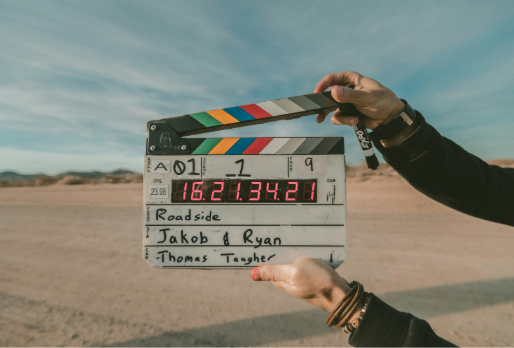
Film and literary connections provide a starting point for experience design. Image reproduced from UPLIFT Implementation Clinic 2, slide 5.
How the workshops and clinics work together
The workshops provide space to explore. They introduce the topic, explain relevant approaches and use discussion questions to help you reflect on your own business, destination or cultural setting. You can capture challenges, opportunities and ideas with colleagues or local stakeholders.
The implementation clinics help you apply that thinking. Their exercises guide you through practical tasks, such as mapping a visitor journey, reviewing available content or sketching a small experience to test. A clinic develops the opportunities identified through discussion; it does not simply supply a fixed answer to every workshop question.
You can use the materials independently, with your team or in a facilitated session. Educators and trainers can use them to help learners work through a real tourism example. The linked workshop and clinic give each topic a useful rhythm: explore the question, try an activity and decide what to do next.
Topic 1 explores where immersion could make a difference
An immersive experience helps visitors feel connected to a story or place and gives them a way to participate. That participation might involve listening to a character’s account, following clues through a town or comparing an old photograph with the view in front of them.
Workshop 1 introduces different ways to achieve this. Some use familiar materials and live storytelling. Others add audio, interactive media or more advanced technologies. The important decision is what the visitor gains from the experience.
| Approach | What it means | A possible tourism use |
| Live or physical storytelling | A guide, performance, prop or activity invites participation | A story card asks visitors to imagine a character’s decision at a particular location |
| Audio and QR codes | A scannable code opens a web page, recording or video | A local voice explains why a room or landscape matters to the story |
| Augmented reality or AR | Digital content appears over a view of the real world | A phone shows an earlier view of a building in its present setting |
| Virtual reality or VR | A digital environment creates the sense of being somewhere else, often through a headset | Visitors explore a recreated story setting that cannot be visited physically |
The workshop asks you to look closely at the experience you already offer. What film or literary connections exist? What do visitors ask about? Where does their interest grow, and where do they leave without understanding the connection? These questions help you identify a genuine opportunity before choosing a tool.
For example, visitors might photograph a building because it appeared in a film but learn little about its role in the story. A short explanation from a guide, supported by an image or recording you have permission to use, could give that stop more meaning. A complex app may add little if the missing element is simply a clear explanation.
Workshop 1 also opens discussion about practical concerns. Will visitors have a suitable device? Is connectivity reliable? Can staff support the activity? Will the digital content fit comfortably into a guided visit? Considering these questions early helps you choose an approach your team can manage.
Clinic 1 maps the experience through the visitor’s eyes
Implementation Clinic 1 begins with the visitor journey. You map what happens before arrival, during the visit and afterwards, then identify the moments where a story could make the experience richer.
A touchpoint is simply a moment when a visitor encounters your offer. It might be a website introduction, a welcome from a guide, a viewpoint or a question asked before leaving. The exercise helps you connect an immersive idea to a specific moment rather than adding digital content without a clear purpose.
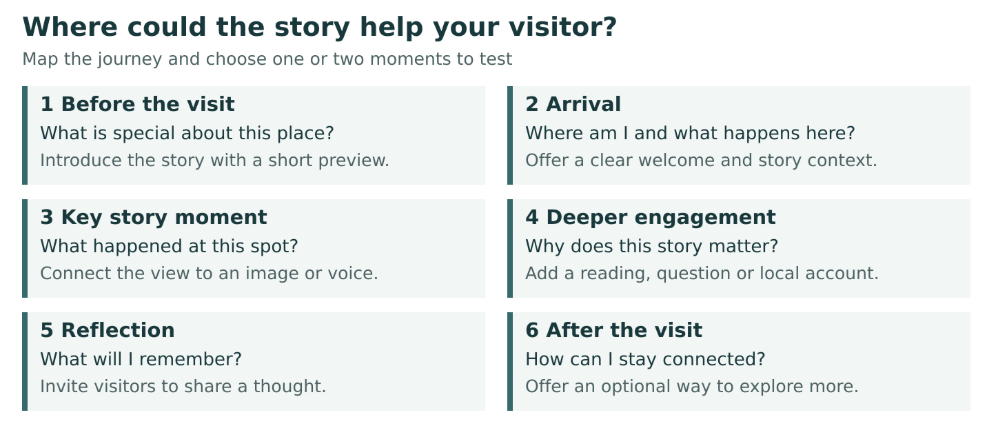
Visitor journey explainer adapted from UPLIFT Implementation Clinic 1, slides 4–12. The actions are examples to consider, rather than a requirement to introduce technology at every stage.
Choose one or two promising moments. Perhaps visitors pause at a particular window but do not know what they are looking at. Perhaps the story feels unfinished when the tour ends. Describe the gap and consider what would help: an image, a short recording, a question, a physical object or an interactive element.
The clinic then introduces a quick technology and content audit. List the devices you can access, the stories you know and the photographs, recordings or other materials available to you. Include the people who could contribute, such as a local historian, guide or storyteller. Record what you still need to check or obtain.
Trying an AR demonstration is another exercise in the clinic. Its purpose is to help you understand the experience from a visitor’s perspective. Notice how easily you can access the content, whether the instructions make sense and whether the digital layer helps you understand the place.
What you can take away: a visitor journey map, one or two immersive opportunities and an initial view of the resources needed to explore them.
Topic 2 connects the idea to your audience and brand
Once you can see an opportunity, the next question is who will value it. Topic 2 helps you connect the experience to your identity, your intended visitors and the goals of your business or organisation.
Positioning means making clear who your experience is for and why they would choose it. Branding includes the story and character people associate with your offer, as well as its visual identity. In an immersive experience, that identity should come through in the language, voices and activities visitors encounter.
Workshop 2 explores audience differences. A film enthusiast may want recognisable locations and production stories. A family may need a short, playful activity. A literature group may appreciate time to listen, reflect and discuss. These are useful starting points for discussion, which you can test against your own visitor knowledge.
It also asks what you want visitors to feel and do. Would you like them to understand a local writer more deeply, spend more time exploring the town or take part in another cultural activity? Choose a goal you can observe or ask about. That gives the eventual pilot a clear purpose.
A story anchor helps hold the experience together. This could be a particular scene, character, author connection or local legend. The workshop encourages you to identify what makes that connection distinctive and to involve people who can represent it well. Bookshops, cultural groups, historians and creative practitioners may bring knowledge that strengthens the experience.
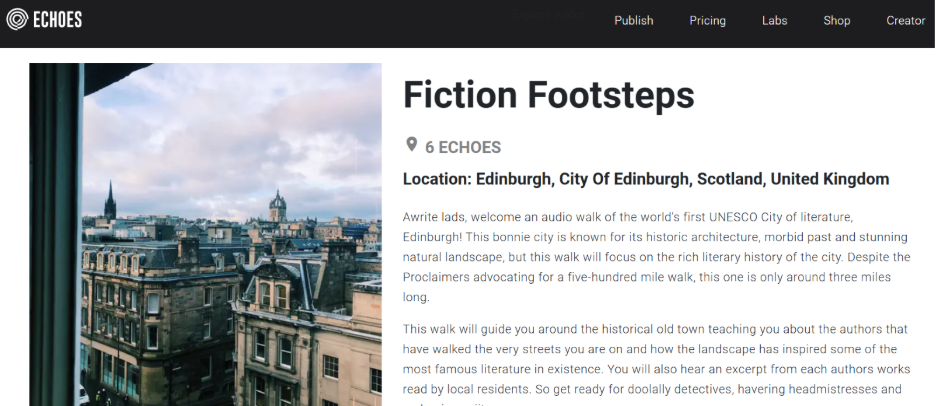
The clinic uses Edinburgh’s Fiction Footsteps to explore the connection between literary places and audio storytelling. Screenshot reproduced from UPLIFT Implementation Clinic 2, slide 16.
Clinic 2 shapes a small experience you can test
Implementation Clinic 2 turns those decisions into a practical concept. It starts with a brand asset map: the stories, media, places and people that could support your idea. An existing paragraph might become a spoken introduction. An old photograph could support a comparison between past and present. A guide’s knowledge could provide the voice for a short scene.
The next exercise is a minimum viable experience. This means a small, coherent version of the idea that is developed enough for visitors to try. The clinic suggests sketching what visitors will see, hear or do during a short activity, then selecting one location or interaction where the story can have an impact.
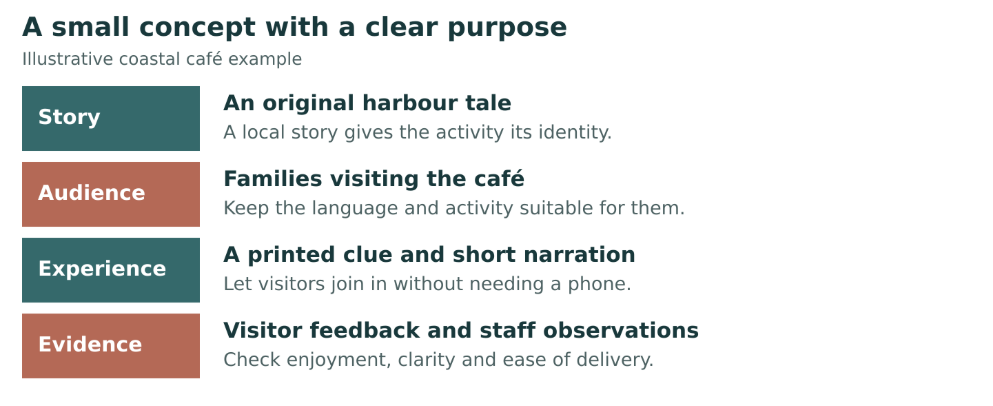
An illustrative concept based on the brand mapping and prototype exercises in UPLIFT Implementation Clinic 2, slides 4–12.
Consider a fictional coastal café using an original harbour tale. The clinic includes a fictional pirate-themed café example to show how a clear story can guide a small activity. A business adapting this approach might offer a printed clue, a brief recording by a local storyteller and a simple interaction at a table.
The useful question is whether visitors enjoy and understand the activity. Does it suit the café’s atmosphere? Can staff deliver it during a busy service? Can someone take part without scanning a code? The answers can guide changes before the business considers adding more content or technology.
What you can take away: a focused concept, a clearly identified audience, a storyboard for one interaction and a practical next step for testing it.
Start with one story and one visitor need
These first two topics give you a way to move from a broad interest in immersive tourism to a defined experience idea. Bring an existing tour, attraction, local story or cultural asset to the exercises. Work through the questions that matter to your context, then use the clinic activities to make the idea more concrete.
The resources are relevant to tourism SMEs, guides, museums, heritage organisations, destination teams and community groups, as well as vocational educators and learners. You can return to the same exercises as your idea develops and use visitor feedback to improve it.
Explore UPLIFT Workshops and Implementation Clinics
View Workshop 1 · Start Implementation Clinic 1
View Workshop 2 · Start Implementation Clinic 2
Don’t forget to check out all UPLIFT’s FREE RESOURCES
The UPLIFT Project offers the following resources:uplifttourism.eu
- Research Reports: Detailed analyses on integrating immersive technologies into tourism, including trends, skills needs, and best practices. https://uplifttourism.eu/resources/immersive-tourism-insights-research-best-practices/
- Compendium of Case Studies: A collection of successful implementations of VR, AR, and AI in tourism, providing practical insights for VET providers and SMEs. https://uplifttourism.eu/resources/immersive-tourism-insights-research-best-practices/
- Immersive Workshops: Hands-on training sessions designed to equip tourism professionals with practical skills in immersive technologies, such as AR, VR, and XR, to create engaging visitor experiences and storytelling https://uplifttourism.eu/workshops-and-clinics/
- Video Lessons and Resources: Educational materials produced from workshops, aimed at a broader audience to disseminate knowledge on immersive tourism practices https://uplifttourism.eu/video-lessons/
- Webinars and Seminars: Online events sharing key insights and best practices in immersive tourism with educators, professionals, and stakeholders across Europe. Register here for our online event on 8th September https://shorturl.at/8Be6w
Written by: Laura Magan, Feltech, Ireland (Uplift Partner)