



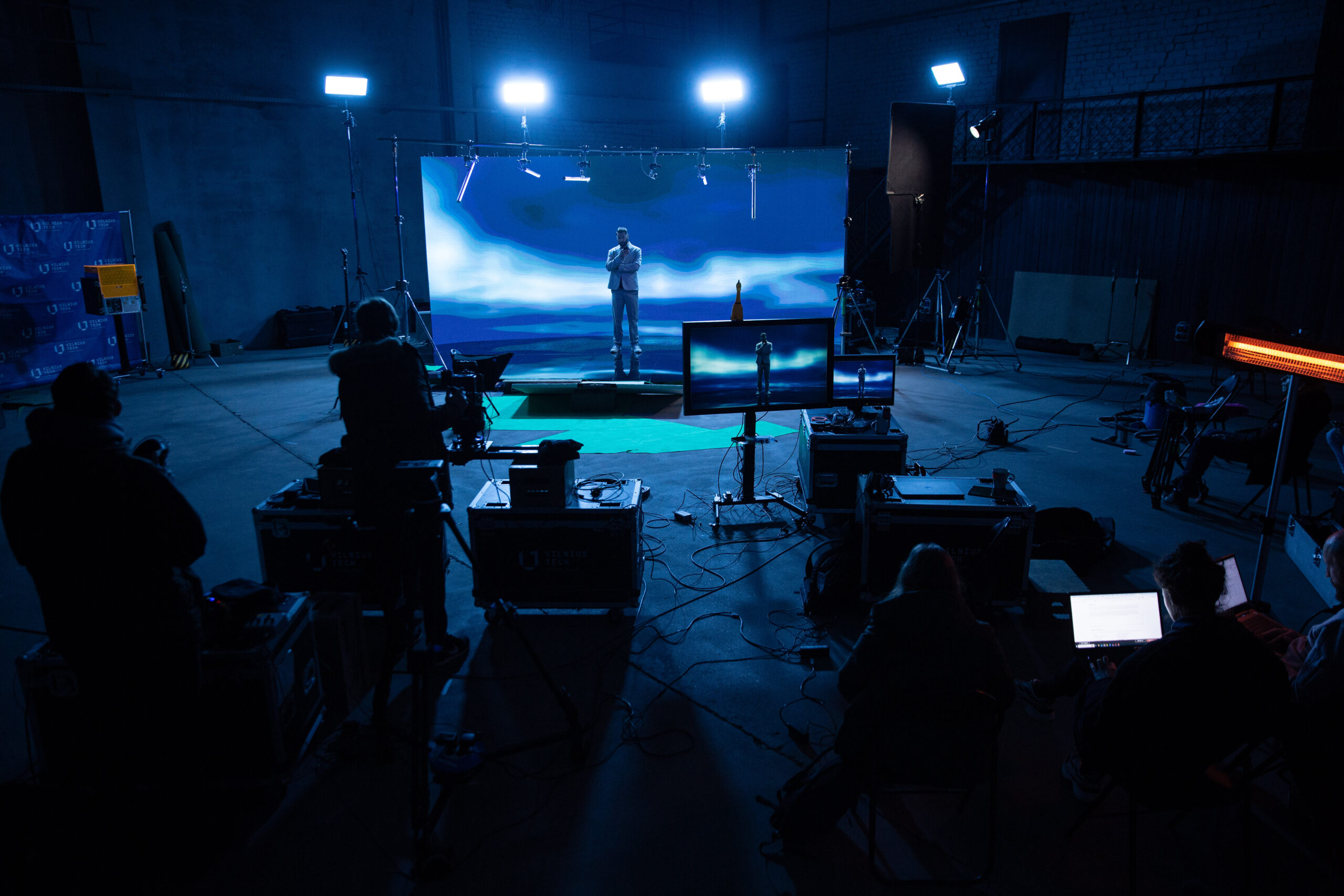
Photo by Renatas Venclovas, VILNIUS TECH “LinkMenų fabrikas“
Blog post by Monika Grinevičiūtė, VILNIUS TECH “LinkMenų fabrikas“
In a 650 m² hangar in Vilnius, a wall of LED panels lets a film crew shoot a Baltic sunset, an Old Town courtyard and a Nordic fjord in one afternoon without leaving the building. UPLIFT took tourism professionals inside to see how the technology works and what it could mean for the places that live on screen.
A film set that never leaves the building
In January 2024, VILNIUS TECH opened Faux Real Studio, the first virtual production studio in Lithuania, inside its Creativity and Innovation Centre „LinkMenų fabrikas“ at Linkmenų g. 28. The name is deliberate. "Faux" is French for something fake that strives to look real, and the studio's whole purpose is to erase the line between the two.
The space is a 650-square-metre drive-in hangar with a modular LED volume: a wall of high-resolution LED screens that shows a digital environment behind the people in front of it. Camera tracking tells the computer exactly where the lens is, so the perspective of the virtual world shifts in real time as the camera moves, just as a real landscape would. The environments are built in Unreal Engine, the same real-time graphics engine used for video games. Motion capture, VR headsets and responsive lighting complete the toolkit.
The result is what the industry calls in-camera visual effects. Instead of filming actors against a green screen and adding the background months later, the final image is captured on set, reflections and all.
Why it matters beyond film
Virtual production was popularised by Hollywood, where series such as The Mandalorian replaced location shoots with LED volumes. The studio's team points out that Europe is now competing hard for this work, with the biggest streaming studios coming to the continent specifically to use virtual production facilities.
For creators, the appeal is practical. A production can move from a mountain pass to a city street by loading a new scene, which cuts travel, transport and post-production costs, saves time and shrinks the carbon footprint of a shoot. The studio's producer has estimated savings of up to 30–50% in cost and shooting time, depending on the project. Faux Real has already hosted part of a Swedish series, Lithuanian music videos and advertising work.
For tourism, the implications are more subtle and more interesting. A destination can be scanned, modelled and "visited" by a camera long before, or long after, a crew sets foot there. A castle can be shown in four seasons on a single day. A literary landscape that no longer exists, such as the Vilnius of a 19th-century novel, can be rebuilt and filmed. Destination marketers, museums and tour operators are only beginning to explore what this means for the content they produce.
UPLIFT in the studio
This is why VILNIUS TECH chose Faux Real Studio as the setting for its UPLIFT immersive workshop. The format was first tested with the UPLIFT partners during the transnational project meeting in Vilnius in October 2025, when colleagues from across the consortium stepped into the LED volume for the first time.
On 23 April 2026 the full workshop, Positioning immersive experiences within your brand, audience and goals, brought a small group of tourism professionals to LinkMenų fabrikas. The first part was theory: how to position an immersive experience within a brand, segment an audience and set goals before buying any hardware. The second part was a hands-on virtual production photoshoot in Faux Real Studio, where participants worked in front of the LED wall and saw how a virtual backdrop reacts to the camera in real time.
The theory session has since become Lesson 1 – Marketing, Branding & Goals, one of four free online video lessons on the UPLIFT website, so anyone in the tourism sector can follow the same reasoning at their own pace.
Where to start
You do not need an LED volume to start thinking like a virtual producer. The workshop's first lesson applies to a smartphone video as much as to a feature film: know who the experience is for, what you want them to feel, and how it fits your brand. Then the technology, whether a VR headset, an AR trail or a day in a studio like Faux Real, becomes a tool rather than a gimmick.
Faux Real Studio offers its services to Lithuanian and international creators, and its equipment is free to VILNIUS TECH students for educational purposes. If you want to see what your destination looks like on an LED wall, Vilnius is a good place to find out.
How UPLIFT ties it together
A studio like Faux Real shows what immersive technology can do. The harder question for a tourism business is what it should do, for whom, and at what cost, and that is the gap UPLIFT was set up to close.
The result is a free, open-access toolkit. The Research Report on Immersive Tourism and the Best Practice Compendium map the trends, the skills gaps and ready-to-replicate examples from across Europe. Four video lessons, each distilled from a partner workshop, take a business from strategy to execution: marketing, branding and goals (the Lithuanian lesson, born in this studio); choosing between VR, AR and XR on the strength of the story rather than the hardware; building a simple VR experience on a budget with 360° photography and free tools; and creative uses of QR codes to link a place with clips and narration. No technical background is needed. Start with Lesson 1, then decide whether the LED wall comes next.