



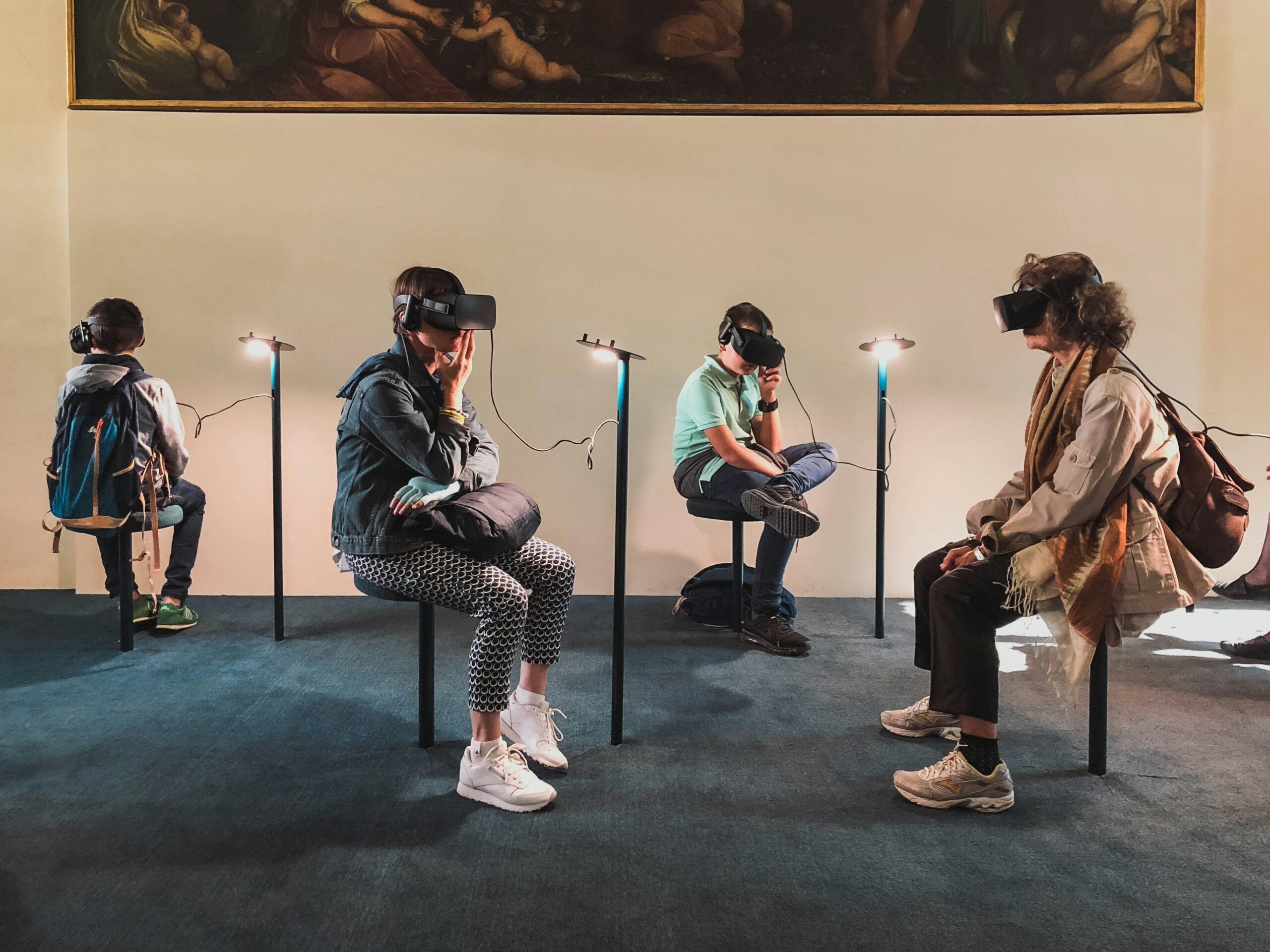
Photo by Lucrezia Carnelos on Unsplash
Blog post by Monika Grinevičiūtė, VILNIUS TECH “LinkMenų fabrikas“
A Lithuanian-made virtual reality journey through the paintings of M. K. Čiurlionis has drawn hundreds of thousands of visitors, won an international prize and now has a sequel playing in five cities. For anyone building an immersive cultural experience, it is the closest thing Lithuania has to a textbook case.
The painter who composed
Mikalojus Konstantinas Čiurlionis (1875–1911) was a painter and a composer who, in a career of barely a decade, left around 300 paintings and some 400 musical works, including the symphonic poems In the Forest and The Sea. He is often described as a forerunner of abstract art, and his canvases are famously musical: cycles called sonatas, mountains that dissolve into stars, cities that float on light. Lithuania celebrated the 150th anniversary of his birth in 2025, and his childhood home in Druskininkai and the National M. K. Čiurlionis Museum of Art in Kaunas remain the anchors of a Čiurlionis trail across the country.
From museum walls to a headset
On 29 August 2018, director Kristina Buožytė and producer Vitalijus Žukas premiered Trail of Angels (Angelų takais), an interactive VR experience built from elements of 60 Čiurlionis paintings over more than two years of work. The viewer drifts through the artist's worlds, and the surroundings respond to where you look, which brings the sensation closer to standing in front of the originals than any screen can.
The experience won the Lumen Prize for art and technology in the United Kingdom in 2019, has been shown in the foyer of Birmingham's Symphony Hall alongside a performance of The Sea, and has toured across Lithuania. The producers put the audience at more than 400,000 people, which for a country of under three million is a remarkable share of the population.
A sequel, and a network of venues
For the 150th anniversary the same team premiered Creation of the Worlds (Pasaulių sutvėrimas) on 21 February 2025. It moves through more than 60 paintings, including the cycles Creation of the World, The City, The Deluge, The Serpent's Sonata, the Tale triptych and The Tale of the Kings, and it turns the viewer from an observer into a participant who shapes and protects the worlds on screen. The soundtrack reinterprets Čiurlionis's music through his great-grandson, the pianist Rokas Zubovas, and the electronic composer Phil Von. The experience itself lasts about 30 minutes inside a 45-to-50-minute session.
The product now lives in a chain of Immersive Art Centres: Vilnius (Vienuolio g. 4), Kaunas (inside the National M. K. Čiurlionis Museum of Art, with museum admission included in the ticket), Klaipėda (Culture Factory, Bangų g. 5A), Utena and Druskininkai, plus a touring programme under the tag #PoLietuvą. Klaipėda offers a multisensory version in which wind, warmth, vibration and scent accompany the visuals. Standard tickets are about €15 (€20 in Vilnius, where the Vilnius Pass includes entry), with reduced, family and multisensory options, school visits through the national Culture Passport scheme, corporate bookings and gift vouchers. Development was co-funded by the Lithuanian Film Centre and the Innovation Agency, and around Čiurlionis's birthday in late September 2026 the Vilnius, Kaunas and Klaipėda centres ran a prize game with 3,000 partner gifts to keep visitors coming back.
What a tourism business can take from it
Start with a story people already love. The VR did not invent Čiurlionis. It opened a new door into an icon that Lithuanians and curious visitors already wanted to understand, and that is why it travels so well abroad.
Put the experience where the visitors are. A museum in Kaunas, a cultural factory in Klaipėda, a spa town in Druskininkai, a touring unit for everywhere else. The headset is the same; the venue strategy is the tourism product.
Keep the product alive. Seven years after the premiere came a sequel, then a multisensory upgrade, seasonal campaigns, family tickets and vouchers. An immersive experience is a service to be maintained, not a film to be released once.
Share the risk. Public co-funding, a national museum partner and a city pass turned a studio project into a destination asset.
The four questions above are answered, in order, by what the project produced. The Best Practice Compendium shows how comparable experiences across Europe were built and financed, and the Research Report explains where the sector's skills gaps lie. Lesson 1 of the free video lessons covers positioning, audience and goals, so the story comes before the headset. Lesson 2 explains the strengths and limits of VR, AR and XR, so a business chooses the technology its story needs. Lesson 3 walks through building a simple VR experience with 360° photography, AI and free tools, which is a prototype you can test on real visitors before spending anything on hardware. Lesson 4 shows how QR codes extend an experience into the streets, trails and museums around it. Together they are the route from a good idea to a product that, like Trail of Angels, can still be selling tickets seven years later.