




Helping tourism SMEs plan and promote immersive film and literary tourism experiences
An immersive tourism idea becomes more useful when you can explain how it will operate, what it will cost and why a visitor would choose it. A compelling story is a strong starting point. Delivering that story also means making time for planning, looking after the people and places involved, and helping visitors understand how to take part.
UPLIFT’s next two Workshops and Implementation Clinics focus on these decisions. Topic 3, Budgeting, Costs, Financial Planning and Responsible Practice, helps you explore the resources and responsibilities behind an experience. Topic 4, Promoting and Selling Immersive Film and Literary Experiences Through Storytelling, looks at communicating its value and making the journey to booking clearer.
Both topics suit small tourism businesses and cultural organisations working with limited resources. You can use them to develop an early idea or review an experience you already offer. The workshops open up discussion, while the matching clinics provide activities to help you plan, test and improve your approach.
Topic 3 uses a Sligo literary trail planning example to explore how the scale of an experience affects its costs. Image reproduced from UPLIFT Implementation Clinic 3, slide 14.
Topic 3 looks at the full cost of the experience
Workshop 3 encourages you to describe the experience clearly before estimating a budget. How many locations will it involve? What will visitors hear, see or do at each one? Who will prepare the content and help people use it? What will need attention after launch?
This makes it easier to distinguish one-off costs, such as initial scriptwriting or equipment purchases, from ongoing costs, such as hosting, subscriptions, staff time and content updates. Both matter. A pilot may be affordable to create but difficult to maintain if the running costs have been overlooked.
The workshop also introduces cost drivers. These are choices that make the budget grow. Adding locations can mean more research, recording and signage. Adding languages can increase translation and review work. Choosing a custom application can introduce additional development, testing and support requirements.
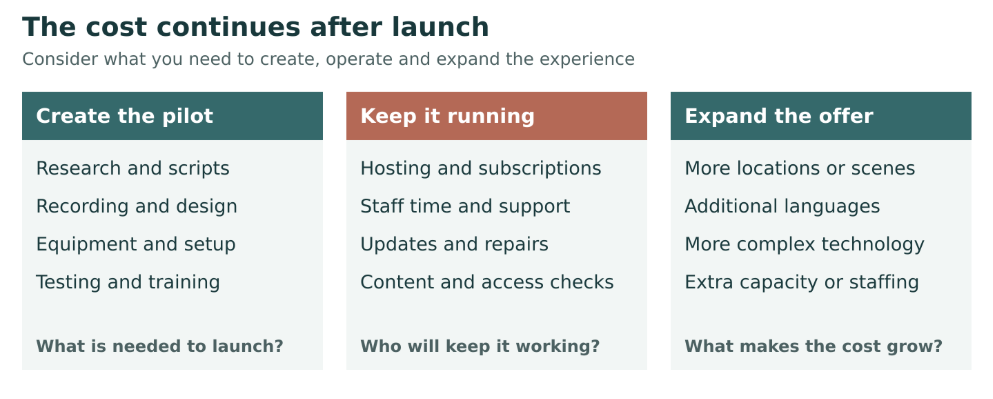
Cost planning explainer adapted from UPLIFT Workshop 3 and Implementation Clinic 3. The categories help you ask what your own experience will require.
The discussion encourages you to separate the essential experience from possible enhancements. What is the smallest version that still communicates the story well? Could existing photographs, recordings or equipment help you test it? Would a partnership with a local cultural organisation or training provider contribute useful skills?
The point is to make the resource needs visible. Borrowed equipment and contributed time can help a pilot, but they still need coordination and may not be available indefinitely. A realistic plan records who is contributing what and who will maintain the experience when the initial activity ends.
Clinic 3 turns the idea into a workable pilot
Implementation Clinic 3 asks you to build a cost model and test the assumptions behind it. Alongside the one-off and recurring distinction, you consider fixed costs, which do not change directly with each additional visitor within the planned capacity, and variable costs, which do.
The Sligo literary trail example in the clinic shows why scope matters. A small route with a few stops and straightforward content has different requirements from a larger offer with more locations, languages and advanced digital features. Treat this as a planning exercise to adapt to your circumstances, rather than evidence of a completed trail or a supplier quotation.
The clinic also introduces financial scenarios. What happens if uptake is lower than expected? What costs continue even during a quiet period? Could the pilot run at a smaller scale while you learn more about demand? These questions help you avoid basing the whole project on the most optimistic visitor forecast.
A simple break even explainer
The following figures are an illustrative teaching example, not UPLIFT project results or current market prices. Assume a pilot has €3,000 in fixed costs for the period being assessed. Each paid participation brings in €8, with €2 in additional variable costs. That leaves €6 per participation towards the fixed costs.
| Paid participations | Contribution at €6 each | Position after €3,000 fixed costs |
| 300 | €1,800 | €1,200 shortfall |
| 500 | €3,000 | Break even |
| 700 | €4,200 | €1,200 surplus |
The calculation is €3,000 ÷ (€8 − €2) = 500 paid participations. This follows the standard break-even formula explained by the US Small Business Administration. The illustration simplifies taxes and timing and assumes the €3,000 captures all fixed costs for that period. A real budget needs your own full costs and realistic capacity assumptions.
You can then assess other benefits separately, such as stronger interpretation, community participation or visitor satisfaction. These may be valuable outcomes, but they do not automatically cover the running costs. The clinic helps you consider both the financial position and the wider purpose of the experience.
What you can take away: a defined pilot, a budget with visible assumptions, scenarios to discuss and a decision about what to test before expanding.
Responsible practice belongs in the plan from the start
Topic 3 also covers copyright, permissions, data protection and ethical questions. These considerations influence the content you can use and the way visitors experience it.
For content, list the photographs, extracts, recordings, music and other material you intend to include. Record who owns each item, what permission or licence applies and what attribution is required. Check each layer of an asset: an older story and a recent recording or film adaptation can involve different rights. The Intellectual Property Office of Ireland’s copyright guidance provides a useful starting point for Irish organisations.
For visitor information, ask what personal data the experience and its chosen platforms process, why it is needed and how it will be protected. That can include booking details, photographs, location information or analytics. The Data Protection Commission’s guidance explains principles including lawfulness, transparency, data minimisation and security. Avoid assuming that a simple QR code or web page has no data implications.
The practical exercises also encourage you to consider access and community representation. Can visitors engage with the story without a smartphone? Is a transcript available for audio? Are the stopping points safe and suitable? Have the people connected to a local story had an opportunity to contribute? Record who will check these matters and resolve outstanding questions before launch.
Maintenance is part of responsible delivery too. Someone needs to check links, review content and respond when equipment or platforms change. Including that responsibility in the pilot plan gives the experience a better chance of remaining useful.
Topic 4 uses the story to explain the experience
Workshop 4 turns to the visitor’s first encounter with your offer. A description such as “interactive heritage experience” may tell someone very little about what they will actually do. A specific story moment can help them picture the visit.
The workshop explores four connected areas: turning story moments into promotional hooks, introducing character or narrator perspectives, creating moments visitors may choose to share, and making the experience easy to understand and book.
A promotional hook is the brief idea that gives someone a reason to look closer. It could focus on a recognisable scene, an unanswered question or a place that shaped a writer’s work. The wording should match the experience you can deliver and make the connection clear to someone who has never visited.
Characters and narrators can provide a useful voice. A guide, local storyteller or performer might introduce the experience through a short recording or video. The workshop also asks where potential visitors will encounter that content, so you can choose channels that fit your audience and your capacity to maintain them.
The materials use examples including Highclere Castle and literary walking tours in Dublin to prompt discussion about the relationship between story, place and promotion. The transferable lesson is to identify the connection your own visitors can understand, rather than assume that recognition of a famous story will be enough.
Clinic 4 creates clearer messages and a route to booking
Implementation Clinic 4 starts by identifying a compelling story moment and turning it into a short message. You then test that message with colleagues, partners or visitors. Does it spark interest? Can they imagine what will happen? Do they understand what they are being invited to do?
For a fictional literary walking experience, a first draft might say “New immersive audio trail”. A more descriptive version could read: “Listen to a local storyteller as you follow the harbour streets that shape our original mystery.” Practical information would then explain the route, duration, access arrangements and price. The promise remains tied to the activity being offered.
The clinic also explores shareable story moments. A suitable viewpoint, story prompt or interaction may give visitors something they want to photograph or discuss. Sharing should remain optional, and promotional requests should respect the site and other people using it.
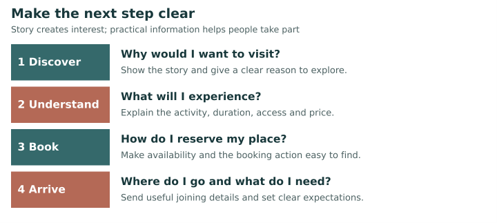
Promotion and booking explainer adapted from UPLIFT Workshop 4 and Implementation Clinic 4, slides 15–17. Each stage answers a different visitor question.
The booking exercise asks you to follow the whole path as a visitor would. Start with the promotional message and open the linked page on a phone. Can you quickly find what is included, where the experience happens, how long it lasts and what it costs? Is availability clear? Does the booking confirmation explain where to go and what to expect?
A story creates interest, but uncertainty can interrupt the next step. The clinic helps you connect the creative message with the practical details needed to participate. A short preview can support that decision, provided it accurately represents the experience.
What you can take away: a tested promotional message, an idea for an appropriate story moment and a clearer route from discovery to participation.
Use the two topics around one real experience
Take the same idea through both topics. In Topic 3, define what you can deliver and how you will maintain it. In Topic 4, explain that offer clearly and test whether someone can understand and book it.
You can work through the exercises as a business team, with community or creative partners, or in an educator-led session. Capture what you learn from a pilot, including costs, visitor feedback and any points of confusion. Use that evidence to decide what to improve and whether expansion makes sense.
Explore UPLIFT Workshops and Implementation Clinics
View Workshop 3 · Start Implementation Clinic 3
View Workshop 4 · Start Implementation Clinic 4
Don’t forget to check out all UPLIFT’s FREE RESOURCES
The UPLIFT Project offers the following resources:uplifttourism.eu
- Research Reports: Detailed analyses on integrating immersive technologies into tourism, including trends, skills needs, and best practices. https://uplifttourism.eu/resources/immersive-tourism-insights-research-best-practices/
- Compendium of Case Studies: A collection of successful implementations of VR, AR, and AI in tourism, providing practical insights for VET providers and SMEs. https://uplifttourism.eu/resources/immersive-tourism-insights-research-best-practices/
- Immersive Workshops: Hands-on training sessions designed to equip tourism professionals with practical skills in immersive technologies, such as AR, VR, and XR, to create engaging visitor experiences and storytelling https://uplifttourism.eu/workshops-and-clinics/
- Video Lessons and Resources: Educational materials produced from workshops, aimed at a broader audience to disseminate knowledge on immersive tourism practices https://uplifttourism.eu/video-lessons/
- Webinars and Seminars: Online events sharing key insights and best practices in immersive tourism with educators, professionals, and stakeholders across Europe. Register here for our online event on 8th September https://shorturl.at/8Be6w
Written by: Laura Magan, Feltech, Ireland (Uplift Partner)