



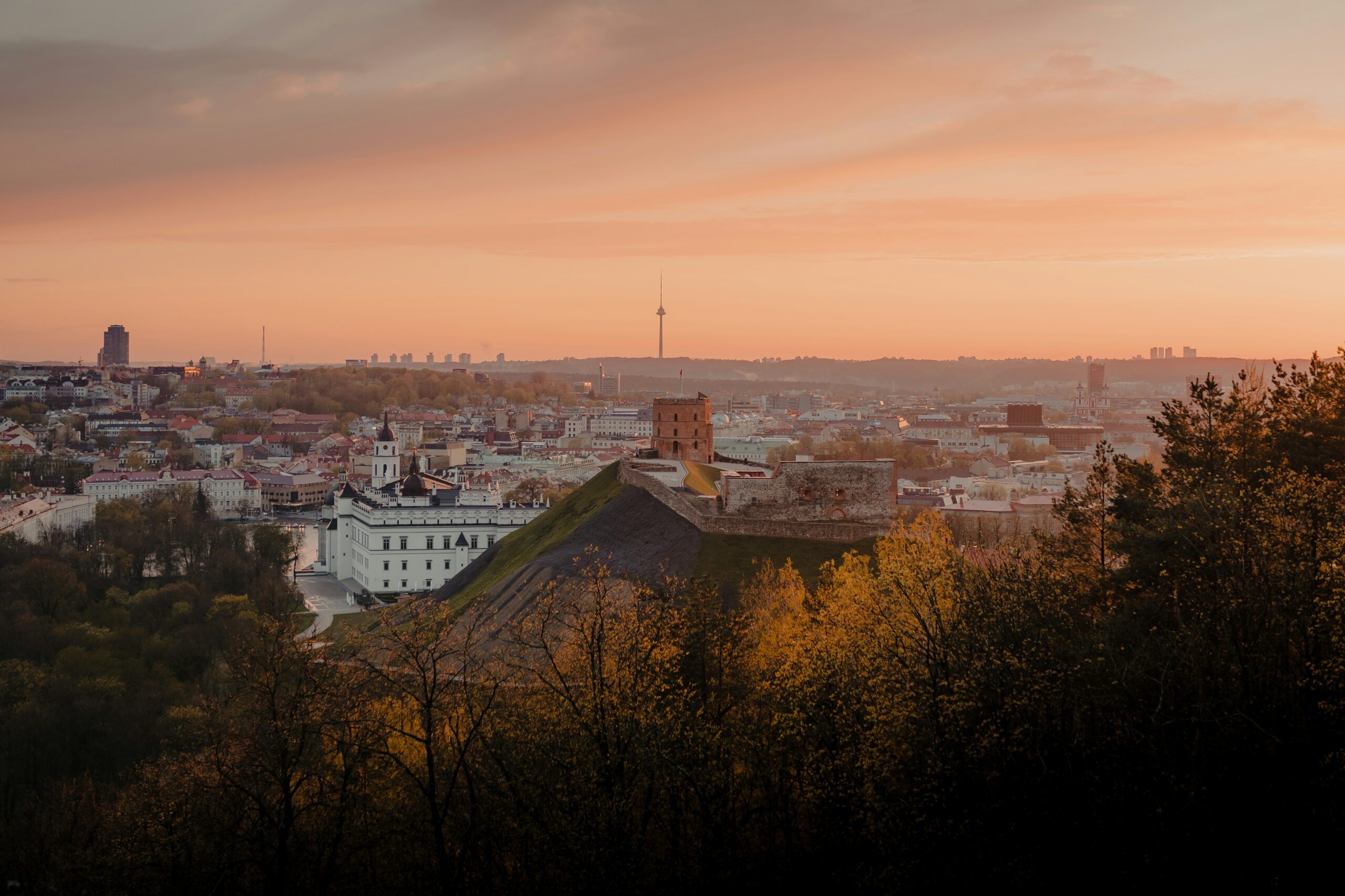
Photo by Gantas Vaičiulėnas on Unsplash
Blog post by Monika Grinevičiūtė, VILNIUS TECH “LinkMenų fabrikas“
In a few short years Vilnius has played Pripyat, imperial St Petersburg, a Soviet prison camp and 1980s East Berlin. Foreign producers spent a record €56 million in Lithuania in 2025, and most of the places they filmed are open to anyone with a map and a story to follow.
A record year on set
Lithuania's film industry had its best year yet in 2025. According to the Lithuanian Film Centre, 108 productions used the national Film Tax Incentive, among them 68 Lithuanian films, 21 co-productions and 19 foreign service projects, and foreign filmmakers spent nearly €56 million in the country, €17 million more than the year before. The money flows well beyond the set, into hotels, restaurants, transport and retail.
The engine behind this is the incentive itself, in force since 2014 and confirmed in its current form until the end of 2028. It lets Lithuanian companies direct part of their corporate tax into film production, covering up to 30% of a project's Lithuanian budget. More than 660 productions have used it so far. In 2025 the largest beneficiary was the first season of the American series Star City, followed by the German series Mozart/Mozart and the Netflix feature Riot (Bunt) from Poland. Scandinavian producers made up the biggest group of foreign shoots, and four German projects a year have become routine.
The new year kept the pace. In early 2026 the six-part series Honey turned Vilnius and other Lithuanian locations into 1980s East Berlin, and in February Andrius Blaževičius took the Best Director award in the World Cinema Dramatic competition at Sundance for How to Divorce During the War, a reminder that Lithuanian creators, not only visiting crews, are putting the country on screen (Lithuania.lt).
The sets you can walk into
Chernobyl (HBO, 2019). The series that put Lithuania on the location map was shot largely in Vilnius, where the Soviet-era housing blocks of Fabijoniškės stood in for Pripyat, and at the decommissioned Ignalina nuclear power plant in Visaginas, which played the plant itself. Guided Chernobyl walks now run through the Vilnius district, and the plant receives visitors by prior arrangement.
Stranger Things, season 4 (Netflix). In early 2020 the crew moved into Lukiškės Prison in the centre of Vilnius, closed in July 2019 after more than a century of use by the Russian Empire, interwar Lithuania, the Nazis and the Soviets, and turned it into the Kamchatka camp where Hopper is held (LRT). The site reopened in 2021 as Lukiškės Prison 2.0, a cultural quarter with artists' studios, concerts, guided tours of the cell blocks and a Stranger Things-themed cell you can book for the night.
Why it works, for crews and for travellers
The reasons producers choose Lithuania are the same reasons it rewards a visitor. Within a few tram stops you pass from a UNESCO-listed baroque Old Town to interwar modernism, Soviet microdistricts, a tsarist-era prison and, two hours away, a nuclear plant. The country is compact, the crews are experienced, costs are moderate and the Vilnius Film Office (filmvilnius.com) smooths the permits.
What is still missing is the layer in between: products that turn "this was filmed here" into an experience. A prison tour and a Chernobyl walk exist; a coherent screen-tourism offer, with routes, apps and partnerships, is only beginning. That gap is exactly where UPLIFT works. Augmented reality can show the scene on the spot where it was shot. Virtual reality can rebuild a set after it has been struck. Virtual production, which Lithuania now has at VILNIUS TECH's Faux Real Studio, can produce destination content that would once have needed a location shoot.
If you run a tourism business
- Map what has been filmed near you. The Film Centre keeps a public list of foreign productions shot in Lithuania.
- Mind the rights. You can tell visitors what was filmed where; you cannot use a show's footage, logo or characters without a licence.
- Build the story around the place, not the show. The series brings people once; the place, well told, brings them back.
- Start small. A self-guided route with QR codes and short clips costs little and tests demand before you invest in headsets.
The four steps above map directly onto the project's free, open-access results. The Research Report and Best Practice Compendium collect working film-trail and screen-tourism examples from across Europe to copy from. Lesson 1 of the video lessons sets the positioning, audience and goals of a film-tourism product. Lesson 2 helps decide where AR, VR or XR earns its place. Lesson 3 shows how to rebuild a location as a simple VR experience with 360° photography and free tools, which is how a set that no longer exists can still be visited. Lesson 4 is the self-guided route in step 4 made concrete: a QR code at a film location that lets a visitor watch the scene shot on that exact spot. Every piece was tested in a partner workshop first, including the hands-on session in VILNIUS TECH's Faux Real Studio, so the path from "filmed here" to a product visitors pay for is already marked out.